
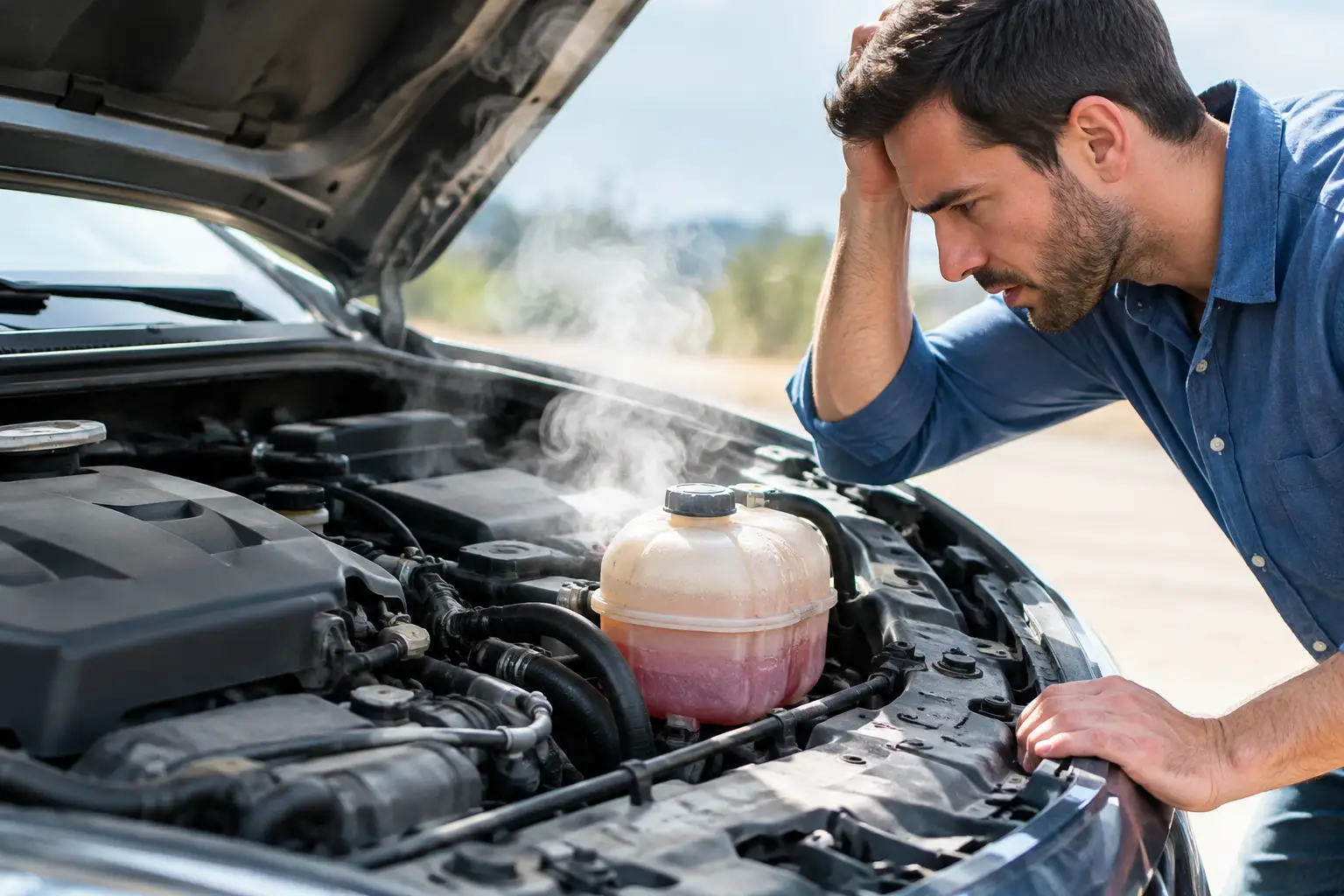
You are on the way to a job, a delivery or the school run when the temperature gauge climbs into the red. Perhaps a warning light appears, steam starts rising from under the bonnet, or the heater suddenly blows cold. This overheating engine example is not a problem to nurse along until you get home. A few extra miles can turn a relatively straightforward cooling-system repair into serious engine damage.
The right response is calm, quick and safety-first. Stop the vehicle as soon as it is safe, let it cool properly, and arrange for the fault to be checked before driving again. For vans and fleet vehicles, that decision protects more than the engine – it protects your workday and avoids a much longer period off the road.
An overheating engine example in real terms
Imagine a Mercedes-Benz Sprinter is travelling through Glasgow with a full day of calls booked in. The driver notices the coolant temperature creeping above its normal position, then the dashboard warning appears while idling in traffic. There is no obvious puddle underneath, but the cab heater has gone cold.
That combination often points to low coolant or poor coolant circulation. The engine may be getting hot because coolant has leaked away, a thermostat has stuck shut, the water pump is not circulating properly, or air has entered the system. Continuing to drive could allow the cylinder head to overheat, damaging the head gasket or causing the head itself to distort.
Not every overheating fault looks the same. A radiator fan issue may only show itself in slow traffic or while stationary, then appear to improve at motorway speed. A small coolant leak can be almost invisible until pressure rises in the system. A blocked radiator may become noticeable under load, such as towing, climbing or carrying a heavy van load. The key point is that an engine which has overheated needs a diagnosis, even if the gauge returns to normal after cooling down.
What causes an engine to overheat?
The cooling system has one job: move heat away from the engine and release it through the radiator. If coolant is low, flow is restricted, pressure cannot be maintained or airflow is insufficient, temperatures rise quickly.
A coolant leak is one of the most common causes. Hoses, clips, radiators, expansion tanks and water pumps can all leak, and some leaks only appear when the system is hot and pressurised. Pink, blue, green or orange residue around components can be a clue, depending on the coolant used. A sweet smell inside or outside the vehicle can also point to coolant escaping.
A failed thermostat is another regular cause. When it remains closed, hot coolant cannot reach the radiator effectively. The gauge may rise sharply, while the radiator or lower hose remains comparatively cool. Water pump faults can create a similar result, particularly where the impeller is worn or damaged.
The radiator fan matters most at lower speeds. If the fan does not operate when it should, the vehicle may overheat in queues, at roadworks or while parked with the engine running. Faults can involve the fan motor, fuse, relay, wiring, temperature sensor or the vehicle’s control system.
More serious causes include a head gasket failure or a cracked cylinder head. These can allow combustion gases into the cooling system, push coolant out, or let coolant enter places it should not be. White exhaust smoke, repeated coolant loss, pressurised hoses from cold, rough running and mayonnaise-like residue under the oil filler cap can be warning signs, although no one symptom confirms the fault on its own.
What to do when the temperature rises
If the gauge moves above normal or an engine temperature warning appears, reduce load on the engine straight away. Turn off the air conditioning, avoid hard acceleration and find a safe place to pull over. Do not keep driving simply because you are close to your destination.
Once stopped, switch the engine off if there is steam, a strong burning smell, coolant loss or a red warning light. Keep clear of traffic and do not open the bonnet immediately if steam is escaping. More importantly, never remove the coolant expansion tank cap while the engine is hot. The cooling system is pressurised, and hot coolant can cause serious burns.
Allow the vehicle to cool fully. This may take considerably longer than a few minutes. When it is safe to inspect, look for obvious signs such as a split hose, a puddle of coolant, a loose undertray dripping fluid or a damaged auxiliary belt. If the coolant level is low, do not assume topping it up solves the underlying problem. It may help identify that coolant has been lost, but the reason it was lost still needs to be found.
If the warning was red, the engine was steaming, or the temperature repeatedly rises, recovery is normally the sensible option. Restarting and hoping for the best is a gamble with an expensive component. A mobile mechanic can assess suitable faults at the roadside, while vehicles needing pressure tests, deeper diagnostics or cooling-system repairs can be brought into the garage.
Why coolant top-ups are not a repair
It is tempting to add water or coolant and carry on, especially when work is waiting. That may be reasonable only as a short-term emergency measure after the engine has cooled, and only if there is no active leak, no continuing temperature warning and the manufacturer-approved coolant is available. Mixing unsuitable coolant types can reduce corrosion protection and create further problems.
The bigger risk is masking the cause. If a leaking hose, failed fan or sticking thermostat remains in place, the next overheat may happen under worse conditions. Repeated overheating is particularly hard on modern diesel engines, where tight tolerances and complex emissions systems leave little room for excessive heat.
For business owners, the cheaper decision is usually early diagnosis. A pressure test can reveal leaks that are not visible when cold. Diagnostic equipment can compare commanded and actual fan operation, check live coolant-temperature readings and identify stored fault codes. Testing the system properly avoids changing parts by guesswork.
How a proper overheating diagnosis works
A technician should start by confirming the complaint and checking the basics: coolant level and condition, visible leaks, hose condition, radiator damage, auxiliary belt operation and signs of contamination. The vehicle can then be tested as it warms up, with live data used to see whether temperature readings make sense and whether the cooling fan is being commanded on.
A cooling-system pressure test is often essential. It simulates the pressure the system sees when hot and can expose leaks from a radiator seam, hose connection, thermostat housing or water pump. Where a head gasket issue is suspected, further tests may check for combustion gases in the coolant and assess cylinder condition.
This process matters because the same dashboard warning can have several causes. Replacing a thermostat will not fix a fan-control fault. Fitting a new radiator will not cure combustion gases entering the cooling system. Accurate diagnosis keeps repair costs fair and gets the vehicle back in service sooner.
Van-Tech Fleet Solutions can provide roadside support and garage-based investigation for drivers who need an overheating issue dealt with without unnecessary delay. For Mercedes-Benz vans, especially vehicles fitted with OM651 or OM654 engines, model-specific knowledge and correct diagnostics are especially valuable when tracing cooling, sensor and circulation faults.
Preventing the next overheating problem
Cooling-system faults are not always avoidable, but routine checks reduce the chance of being caught out. Check coolant level only when the engine is cold, and investigate any regular drop rather than continually topping it up. Pay attention to temperature warnings, a heater that changes temperature unexpectedly, new coolant smells and fans running loudly after a journey.
Servicing is also the right time to inspect hoses, clamps, radiator condition and coolant quality. Fleet operators should encourage drivers to report early warning signs rather than wait for a breakdown. A van that is still moving can feel like a vehicle that is fine, but an abnormal temperature reading is the vehicle telling you it needs attention.
If your engine temperature rises, protect the engine first and the schedule second. A prompt check may cost you part of a day; ignoring it can cost you an engine and far more time off the road.