
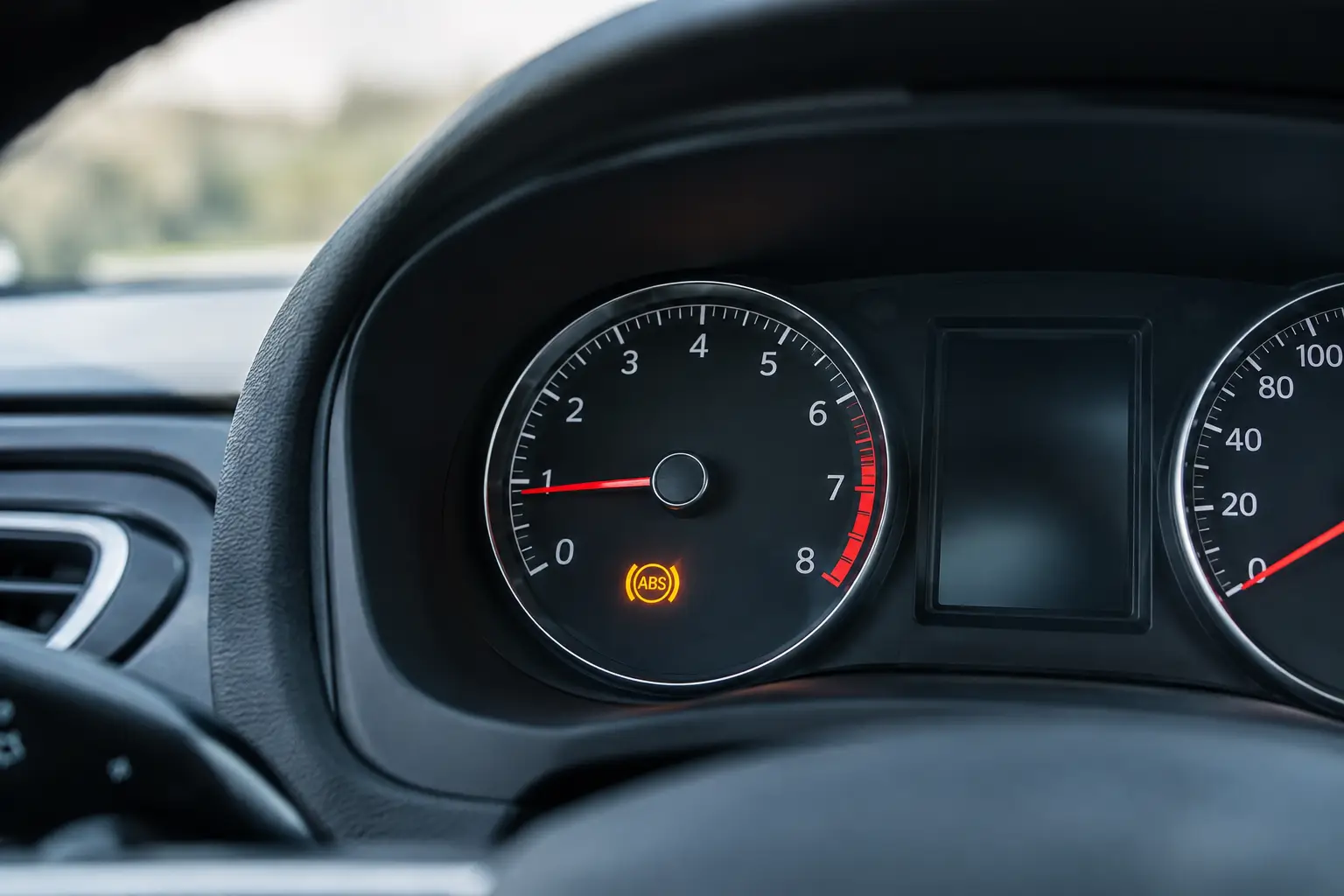
The ABS light comes on halfway through a delivery round, or just before the school run. The brakes still feel normal, so it is tempting to carry on and deal with it later. That is a common ABS fault example, but it needs proper attention. Your vehicle will usually still have conventional braking, yet the anti-lock function may no longer be available when you need it most – during a hard stop on wet Glasgow roads, loose surfaces or ice.
A warning light is not a diagnosis. It is the vehicle telling you that the ABS control unit has found a fault and may have switched the system off to prevent unreliable operation. The answer could be a simple damaged wheel-speed sensor or wiring repair. It could also be a corroded reluctor ring, a wheel bearing issue, low system voltage or a fault within the ABS hydraulic unit. Reading the fault codes is the starting point, not the finish.
What happens when an ABS warning light comes on?
ABS stands for anti-lock braking system. Under heavy braking, it monitors the speed of each wheel. If one wheel is about to lock, the system rapidly adjusts brake pressure so that the tyre can keep turning. This helps you retain steering control rather than sliding straight on.
When the ABS warning light stays on after the engine starts, the system has detected a problem and usually disables ABS assistance. On many vehicles, the standard hydraulic brakes continue to work normally. However, you should not assume the vehicle is safe to use as usual. A sudden stop may feel very different, especially in the wet or with a loaded van.
Some vehicles also show traction control, stability control or brake warning messages at the same time. These systems often rely on the same wheel-speed information. If a red brake warning light is on, the brake pedal feels soft, fluid is leaking, or braking performance has changed, stop driving and arrange recovery. That is no longer just an ABS issue.
A realistic ABS fault example
A tradesperson notices the ABS and traction-control lights on their Mercedes van after driving through standing water. The brakes feel fine around town, but the lights return every time the vehicle is driven. A basic code read points to an intermittent front-left wheel-speed sensor signal.
Replacing the sensor without checking anything else might cure it, but it is not always the right repair. A technician should inspect the sensor wiring where it passes behind the wheel, check for water ingress and damage, examine the connector, and assess the wheel bearing and magnetic encoder ring. On some vehicles, corrosion, a loose bearing or damage hidden behind the hub creates the poor signal rather than the sensor itself.
Live data is useful here. During a road test or with the wheels safely checked, the technician compares all four wheel-speed readings. If one wheel drops to zero, jumps around or reads differently at low speed, it points the investigation in the right direction. The final repair may be a sensor, a wiring section, a bearing or hub assembly. That is why an accurate diagnosis can save money compared with changing parts on guesswork.
Common causes of an ABS fault
Wheel-speed sensor faults are among the most frequent causes. Sensors live in a harsh area close to road spray, heat, vibration and salt. Their cables can rub through, connectors can corrode, and the sensor itself can fail internally.
Wiring damage is particularly common on working vans that cover high mileage, use rough sites or regularly carry heavy loads. A cable may look acceptable from above but be broken inside the insulation or damaged where it flexes with suspension movement.
Wheel bearings can also trigger an ABS warning light. Many modern bearings include a magnetic encoder that the sensor reads. If the bearing is worn, fitted incorrectly, contaminated or damaged, the ABS module may receive an implausible wheel-speed signal. In these cases, fitting a new sensor alone will not solve the problem.
Other possible causes include a blown fuse, weak battery, charging-system fault, poor earth connection, brake-fluid issues, damaged reluctor rings on older designs, or an internal fault in the ABS pump and control module. The last of these is less common than sensor and wiring faults, but it requires careful testing before any expensive replacement is authorised.
Can you drive with an ABS fault?
It depends on the symptoms, but an illuminated amber ABS light should be treated as a safety repair, not a cosmetic warning. If the brake pedal is firm and the only warning is the amber ABS light, you may be able to drive cautiously to a repairer. Leave more space, avoid harsh braking and do not rely on traction or stability systems that may also be unavailable.
For a fleet vehicle, the operational question matters too. Sending a van out for a full shift with a known ABS warning can expose the driver, the load and the business to unnecessary risk. It can also turn a small repair into a missed job or breakdown if the fault worsens.
Do not drive if the red brake warning light is on, the pedal travels unusually far, the vehicle pulls sharply under braking, you hear grinding, fluid is low, or multiple warning messages appear with a clear loss of braking confidence. Park safely and get help. Brakes are not a system to take chances with.
Why fault codes are only one part of the job
Diagnostic equipment may report wording such as front-right wheel-speed sensor circuit, signal implausible, pump motor fault or communication error. That information is valuable, but it does not automatically identify the failed component.
For example, a sensor circuit code could be caused by the sensor, the plug, damaged wiring, corrosion in a connector or an issue at the ABS module. An experienced technician combines the codes with live readings, visual checks, voltage and continuity tests, and an understanding of the vehicle’s known weak points.
This matters most when a van is needed for work. A cheap code scan followed by an unproven parts replacement may seem quicker, but repeat visits and further downtime soon cost more than a structured diagnosis. The right approach is to confirm the fault, explain the repair clearly and only replace parts that have failed or are demonstrably causing the issue.
What to do when the ABS light appears
First, pay attention to the warning lights and how the brakes feel. If there is any sign of a broader braking fault, stop and arrange assistance. If the vehicle feels normal but the amber ABS light remains on, book a diagnostic inspection promptly rather than clearing the code and hoping it stays away.
Avoid repeatedly disconnecting the battery or using a basic scanner to erase the warning. The light may stay off briefly, but the fault is likely to return and the stored information that helps trace an intermittent issue can be lost. If the warning appeared after tyre, bearing, suspension or brake work, mention that when booking in. It can be a useful clue.
At Van-Tech Fleet Solutions, we check the underlying cause rather than simply chasing the dashboard message. For drivers and fleet operators around Glasgow, that can mean mobile assessment where suitable or garage-based testing when the repair needs more involved inspection. The aim is straightforward: a safe repair, a clear explanation and as little time off the road as possible.
Preventing repeat ABS problems
Not every ABS fault is preventable, but regular servicing gives wiring, wheel bearings, brake components and fluid condition a chance to be checked before a warning light interrupts your day. After any wheel bearing or suspension repair, correct fitting matters. A damaged encoder ring or trapped sensor cable can create a new fault immediately.
Keep an eye on battery health as well. Modern vehicles do not respond well to low voltage, particularly after repeated short journeys, cold starts or long periods parked up. A battery or alternator issue can produce warning lights that appear unrelated at first glance.
An ABS light may not stop the engine running, but it is a clear sign that one of your vehicle’s key safety systems needs attention. Get it checked while the fault is still contained, and you are far more likely to be back on the road with confidence rather than dealing with an avoidable disruption at the worst possible time.