
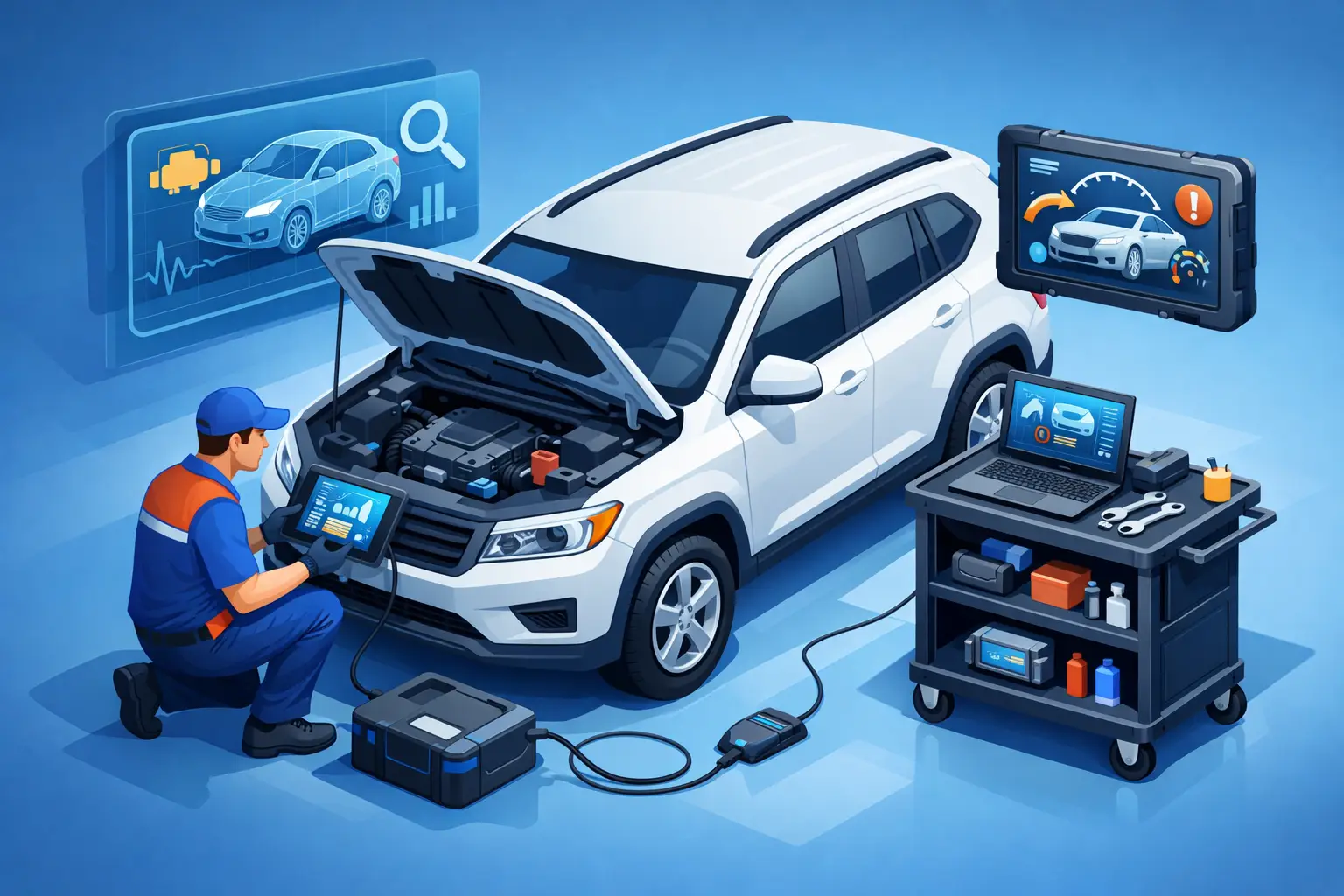
A warning light comes on, the van drops into limp mode, or the engine starts misfiring just before a job. That is usually when people ask, can a mobile mechanic do diagnostics, or do you need to get the vehicle straight into a garage? In many cases, yes, a mobile mechanic can carry out proper diagnostics at your home, workplace or roadside and save you the hassle of towing or arranging time off the road.
The short answer is that diagnostics is not just about plugging in a code reader and reading a fault code. Proper diagnostics means checking what the vehicle is doing, what the control units are reporting, and whether the fault points to a sensor issue, wiring problem, mechanical fault or something more involved. A capable mobile mechanic can do a lot of that on-site. The real question is not whether it can be done at all, but how far the diagnosis can go before workshop equipment or strip-down becomes necessary.
Can a mobile mechanic do diagnostics on most vehicles?
For many everyday faults, the answer is yes. Modern mobile diagnostics equipment can communicate with most cars and vans, pull fault codes, read live data, clear codes where appropriate, and carry out system checks on key components. That is often enough to identify why an engine management light, ABS light, airbag light or DPF-related warning has appeared.
This is especially useful when the vehicle still starts and runs, but not properly. If your van is hesitating, smoking, lacking power or cutting out intermittently, on-site diagnostics can often narrow the issue down quickly. That matters if you rely on the vehicle for work and cannot afford half a day lost sitting in a garage waiting room.
A good mobile mechanic will also look beyond the scan tool. Fault codes only tell part of the story. For example, an EGR fault code might be caused by the valve itself, but it could also be linked to carbon build-up, a wiring fault, a pressure issue or another part of the emissions system. Reading the code is the starting point, not the finish line.
What mobile diagnostics can usually cover
On-site diagnostics are often enough for engine management faults, battery and charging issues, starting problems, sensor-related faults and many electrical issues. A technician can usually check live readings, inspect likely failure points, test the battery and alternator, and assess whether a repair can be completed there and then.
For vans and fleet vehicles, this can make a big difference. If a delivery van is off the road, every hour counts. A mobile visit can confirm whether the problem is something straightforward like a faulty battery, crank sensor or boost hose, or whether it needs workshop time for deeper investigation.
Air conditioning diagnostics can also often start on-site, as can checks for suspension issues, brake warnings and certain drivetrain faults. If a warning light is linked to a known issue on a particular make or engine, an experienced technician may recognise the pattern quickly and save a lot of guesswork.
That is one reason specialist knowledge matters. Some vans, particularly Mercedes-Benz models, have recurring faults that need more than generic code reading. Knowing the common issues on OM651 and OM654 engines, for example, helps turn a fault code into a more accurate diagnosis.
When mobile diagnostics has limits
There are cases where a mobile mechanic can identify the likely problem but not complete the full diagnosis on the roadside or driveway. That does not mean the visit was not worthwhile. It often means the fault needs workshop conditions to confirm and repair properly.
If the issue requires the vehicle to be lifted, components removed, smoke testing, advanced wiring checks, or specialist bench testing, a garage is usually the better place for the next step. Intermittent electrical faults can also be awkward because they may disappear during the visit and only show up under certain driving conditions.
Some faults sit between electronic diagnosis and mechanical inspection. A scan may suggest a fuel pressure problem, but the root cause could be a failing injector, pump issue, leak or internal engine wear. At that point, you may need a more involved process than can realistically be done kerbside.
This is where having both mobile support and a workshop behind it is valuable. You get the speed and convenience of on-site diagnosis first, but if the fault needs more time or equipment, there is a clear next step rather than starting again with someone else.
Why fault codes alone are not enough
People often assume diagnostics means plugging in a machine and being told exactly what part to replace. Realistically, it is rarely that simple. A fault code tells you what system has noticed a problem. It does not always tell you why the problem has happened.
Take a diesel van with a DPF warning and poor performance. The code may point towards blocked regeneration, but the underlying cause might be repeated short journeys, a faulty temperature sensor, an EGR issue, low fuel pressure or another engine fault that is stopping regeneration from completing. Replacing the wrong part is expensive and wastes more time than the original fault.
That is why proper diagnostics needs judgement. A mechanic should combine scan data with physical checks, known failure patterns and how the vehicle is behaving in real life. The better the diagnosis, the less chance of throwing parts at it and hoping for the best.
Is a mobile mechanic as good as a garage for diagnostics?
Sometimes yes, sometimes no. If the fault can be assessed electronically and checked with portable tools, a mobile mechanic can be just as effective as a garage, and far more convenient. If the fault needs major disassembly, ramp access or workshop-only equipment, a garage will have the advantage.
The smarter way to look at it is this: mobile diagnostics is often the fastest first move. It gets a trained technician to the vehicle, confirms whether the fault is minor or serious, and helps you avoid unnecessary recovery or guesswork. For many drivers and fleet operators, that first step is exactly what keeps downtime under control.
There is also a practical benefit in seeing the fault where it happens. Some vehicles behave differently on a cold start outside a house than they do once they have been driven into a workshop. The same applies to non-starts, battery drain issues and faults that show up under your normal daily use.
Can a mobile mechanic do diagnostics at the roadside?
Often, yes, provided the vehicle is in a safe location and the conditions allow it. Roadside diagnostics can be especially useful after a breakdown, a sudden warning light, or a no-start situation. A mechanic may be able to confirm whether the issue is battery-related, sensor-related, fuel-related or likely to need recovery.
That kind of call-out can stop a small problem turning into a bigger one. If the issue can be repaired there and then, you are moving again quickly. If not, you still get a clearer picture of what has failed and what needs to happen next.
For business users, that clarity matters. If you manage a small fleet, you need to know whether a van will be back out today, tomorrow, or after workshop repair. Diagnostics is not just about finding the fault. It is about making a faster, better decision.
What to expect from a proper mobile diagnostic visit
A professional diagnostic visit should start with the symptoms, not the machine. You should be asked what the vehicle is doing, when the fault started, whether any work has been done recently, and whether the issue is constant or intermittent. From there, the technician should run the right checks, explain the findings clearly, and tell you whether the repair can be done on-site or needs to move into the garage.
You should also expect honesty. Sometimes the answer will be straightforward. Sometimes it will be, this needs more time, more testing or workshop access before we can say for certain. That is not a weakness. That is proper diagnosis.
For drivers across Glasgow and surrounding areas, the biggest advantage is simple: less disruption. If the vehicle can be checked where it sits, you avoid the usual chain of delays that comes with getting it to a garage first and asking questions later.
So, can a mobile mechanic do diagnostics? Absolutely – and for many faults, it is the quickest and most practical place to start. The key is using a technician who understands that diagnostics is not just reading codes, but finding the real cause and getting you closer to the right fix without wasting time. If your car or van is showing signs of trouble, getting it checked early usually costs less than waiting for the problem to choose the worst possible moment.