
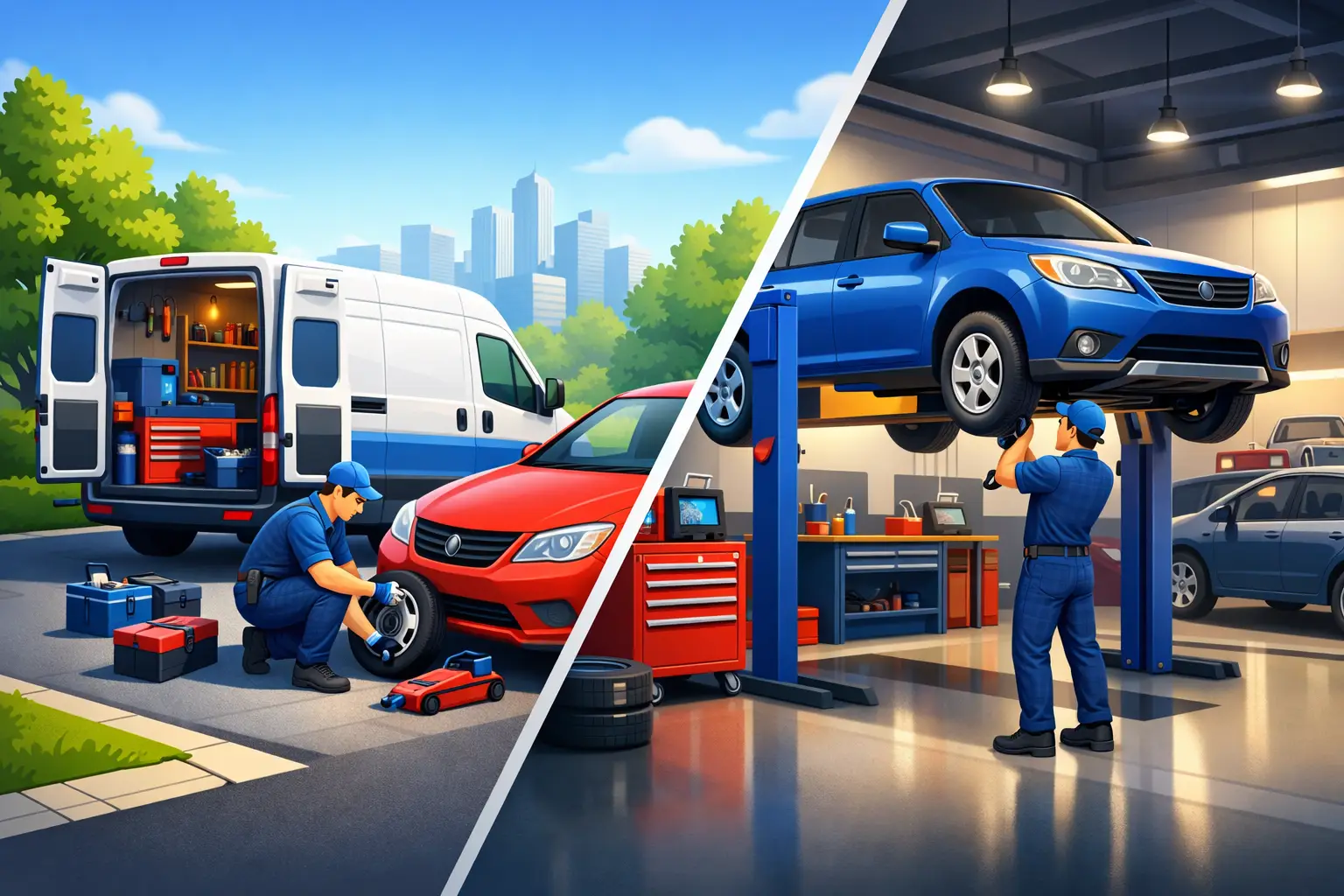
A van that will not start outside a customer’s house at 7am creates a very different problem from a car that is due a routine service next week. That is why mobile mechanics vs traditional garages: which is better? does not have one answer for every driver. The right choice depends on the fault, where the vehicle is, how urgently you need it back and whether the repair needs workshop equipment.
For drivers and businesses around Glasgow, the best outcome is often not choosing one model over the other. It is having access to a technician who can come to you when that saves time, but who also has a properly equipped garage behind them when the job demands it.
Mobile Mechanics vs Traditional Garages: The Real Difference
A mobile mechanic brings the technician, diagnostic equipment, tools and commonly needed parts to your home, workplace, roadside location or depot. This is particularly useful when a vehicle is immobilised, unsafe to drive or simply cannot be taken out of service during the working day.
A traditional garage brings the vehicle into a fixed workshop. That normally means ramps, heavier lifting equipment, specialist machinery, more space and access to a wider range of parts and technical support. It can involve dropping the vehicle off and arranging transport, but it is often the safest and most efficient setting for involved repairs.
Neither is automatically better. Mobile work removes the journey and waiting around. Garage work removes practical limits when a repair needs room, lifting access or extended testing. A reliable repair business should be honest about which option suits the fault rather than trying to force every job into one booking type.
When a Mobile Mechanic Is the Better Choice
Mobile repairs are built around convenience, but convenience is not a small benefit when your vehicle earns its keep. A self-employed joiner, courier or small fleet operator may lose more in missed work than the cost of the repair itself. Avoiding recovery, depot disruption and a day off the road can make a mobile visit the sensible financial choice.
Breakdowns and no-start faults
If your car or van will not start at home, outside a job or on a commercial site, arranging a garage appointment is not much help until the vehicle can move. A mobile mechanic can assess the issue where it sits, carry out diagnostics and, where possible, repair common faults on site. Battery and charging issues, sensor faults, starting problems, brakes, suspension concerns and many service items can often be dealt with without towing the vehicle anywhere.
This is especially valuable outside standard hours. A prompt mobile assessment can tell you whether there is a safe fix, whether the vehicle can be moved, or whether it needs recovery. That clarity prevents wasted time and avoids driving a vehicle that may cause more damage.
Routine servicing at your workplace or home
For planned maintenance, mobile servicing can be a straightforward way to keep on top of the basics. Oil and filter changes, inspections, brake checks, fault-code scans and selected replacement parts can be completed while you are at work or at home, provided there is safe access to the vehicle.
For fleet managers, this can mean vehicles are serviced at the yard in rotation instead of losing several drivers to garage drop-offs. It is a practical way to reduce downtime, particularly for vans that are booked onto jobs every day.
Fleet support where time matters
A mobile technician can spot developing faults before they turn into a missed delivery or cancelled call-out. Regular checks on tyres, brakes, fluid levels, warning lights and diagnostic faults help operators plan repairs rather than reacting to a roadside failure.
The benefit is not just speed. It is having clear information: what needs attention now, what can be scheduled, and what should not be driven. That helps a business control both risk and cost.
Where Traditional Garages Have the Advantage
A garage is not less convenient because it has a fixed location. For some work, it is the only sensible place to do the job properly. The important question is whether the repair requires workshop conditions, not whether a vehicle can physically be worked on outdoors.
Repairs that need ramps, heavy equipment or time
Jobs underneath a vehicle are often safer and more accurate on a lift. Major suspension work, exhaust repairs, wheel-bearing replacement, clutch work, gearbox issues, complex engine repairs and anything requiring significant dismantling usually belong in a garage.
A workshop also makes it easier to deal with seized bolts, corrosion, fluid handling and unexpected findings. Those are common realities on older vehicles and working vans. Trying to complete a difficult repair on a driveway in poor weather can turn a planned job into a longer, more expensive problem.
Specialist diagnostics and technical repairs
Modern vehicles can need more than a generic fault-code reader. Manufacturer-level diagnostics, wiring investigations, live data testing and system resets may require dedicated equipment, stable power supplies and time to test the repair properly.
This matters for specialist vehicles such as Mercedes-Benz vans with OM654 or OM651 engines. Accurate diagnosis is vital before replacing parts. A warning light can be caused by several different issues, and fitting parts by guesswork is rarely the cheapest route. The same applies to Transit wet belt replacements, where correct procedures, parts and workshop conditions are essential.
MOT preparation and follow-up work
A mobile mechanic can inspect a vehicle before its MOT and carry out many common preparation repairs. However, the MOT test itself must be completed at an authorised test station. If a vehicle needs extensive work following a failure, a garage can often manage the repair, re-check and preparation process more efficiently.
Cost: Look Beyond the Hourly Rate
It is tempting to assume a mobile mechanic is always cheaper because there is no large workshop overhead, or that a garage is always better value because it has more equipment. Real repair costs are more complicated.
Mobile visits may include travel or call-out charges, particularly for urgent or out-of-hours support. But they can save money on recovery, taxis, replacement vehicles and lost working time. For a van that needs to be on site by morning, those savings can outweigh the cost of a call-out.
Garage repairs may take longer on paper because the vehicle has to be booked in and dropped off. Yet the right equipment can make a complex job quicker, safer and less likely to need repeat work. A low initial quote is poor value if the fault has not been diagnosed properly or the repair cannot be completed to a good standard.
Ask for a clear explanation of the fault, the recommended work, likely parts costs and any uncertainty before authorising repairs. Honest communication matters more than a headline price. Good technicians will explain what is urgent, what can wait and why.
Practical Limits of Mobile Repairs
Mobile service has to be carried out safely. A level, accessible parking area is usually needed, along with enough room to work around the vehicle. Weather can affect certain jobs, and roadside repairs may be limited by traffic conditions, lighting or the risk to the technician and other road users.
Parts availability can also shape the answer. A technician may carry common items, but specialist parts may need ordering. If the vehicle needs to be dismantled while waiting for a component, a garage is usually the better setting. There is no value in promising an on-site repair when the correct outcome is a controlled workshop job.
How to Choose Without Losing Time
Start with the vehicle’s condition. If it is immobilised, has a warning light, will not start, has a minor repair need or cannot easily leave your premises, ask for a mobile assessment. Give the technician the registration, make and model, symptoms, dashboard messages and any recent work carried out. A short video of the noise or warning light can help too.
If the problem involves major mechanical work, an oil leak of unknown origin, serious drivetrain symptoms, a complex electrical fault or repairs underneath the vehicle, expect a garage booking. Do not keep driving if there is a braking issue, overheating, severe knocking, a strong fuel smell or a warning that affects safety.
For commercial vehicles, decide based on downtime rather than convenience alone. A mobile visit may keep a lightly affected van working. A planned garage slot may be the smarter move if it prevents a bigger failure later in the week. Van-Tech Fleet Solutions combines mobile response with garage-based support in Uddingston, so the repair can move to the right setting without leaving you to start again with another provider.
The best service is the one that gets the diagnosis right, explains the next step plainly and returns your vehicle safely to the road with the least possible disruption.